
The Meta Ad Library (formerly the Facebook Ad Library) gives you free, public access to every ad currently running across Meta’s platforms.
Whether you are researching a competitor’s creative strategy, looking for inspiration before launching a new campaign, or auditing messaging trends in your industry, the Ad Library is one of the most useful tools available to advertisers, researchers, and journalists today.
With Meta generating $196.2 billion in ad revenue during 2025 and reaching 3.6 billion daily active users across Facebook, Instagram, WhatsApp, and Messenger, the Ad Library gives you a window into the largest social advertising ecosystem in the world.
In this guide, I will walk you through how to access the Ad Library, how to use its filters and search features, what data you can actually pull from it, and how to apply what you find to your own campaigns.
I have also added a section on interpreting the wave of AI-generated ad creative that now fills the Library, since that is a major shift from how things looked even two years ago.
What Is the Meta Ad Library?
The Meta Ad Library is a searchable, public database of all active ads running across Meta’s advertising network. Meta originally launched it in 2019 as a transparency tool in response to concerns about political advertising on Facebook.
Since then, it has grown into a full-scale competitive intelligence resource for marketers.
The Ad Library shows you:
- The full ad creative (image, video, or carousel) along with the ad copy, headline, and call-to-action button
- The date the ad started running and whether it is currently active
- Which Meta platforms the ad appears on (Facebook, Instagram, Messenger, Audience Network, Threads, or WhatsApp)
- Multiple versions of the same ad if the advertiser is running A/B tests
- For political or social issue ads: spend ranges, impression estimates, and demographic breakdowns
You can access the Ad Library for free, without needing a Meta account, by visiting facebook.com/ads/library.
How to Access and Search the Meta Ad Library
There are three ways to get into the Ad Library:
1. Direct URL: Go to facebook.com/ads/library and use the search bar at the top of the page. You can search by advertiser name, page name, or keywords related to your industry.
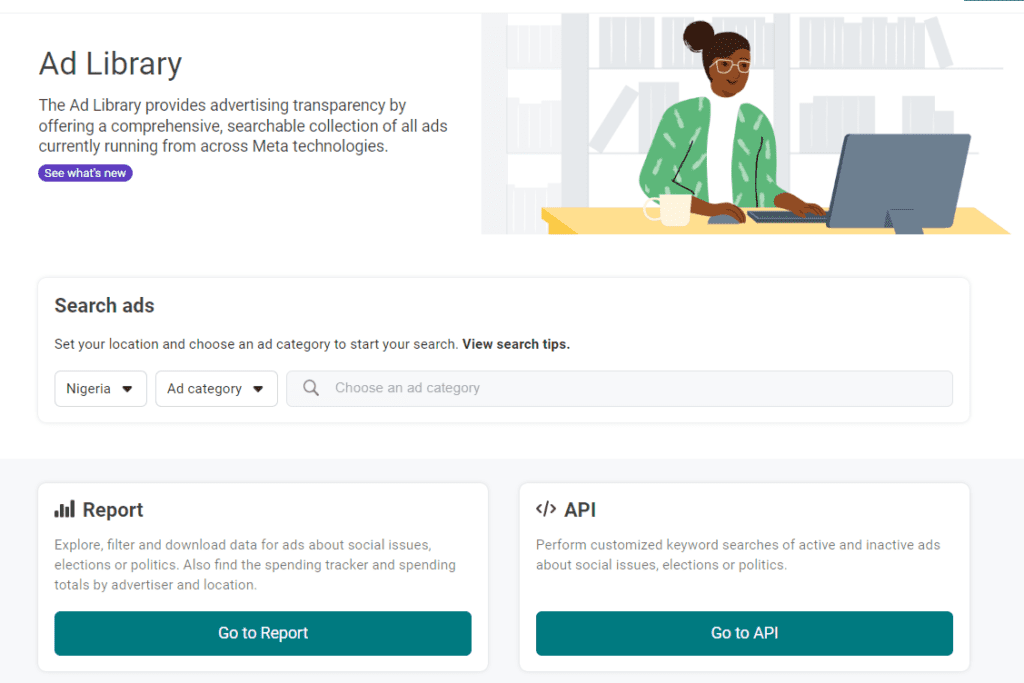
Once you have entered a keyword or an advertiser’s name, click through to see all relevant ads.
2. From a Facebook Page: Visit any public Facebook Page, click on the Page’s name, then select “Page Transparency”. From there, choose “Go to Ad Library” to see every ad that Page is currently running.
3. From an ad in your feed: When you see a sponsored post on Facebook or Instagram, tap the three-dot menu on the ad, select “Why am I seeing this ad?”, then “Advertiser choices,” and finally “See ad details in the Meta Ads Library.”
For detailed research, I recommend using the desktop version. The filtering options are more comprehensive and it is easier to scan through large volumes of ads quickly.
Using Filters to Narrow Your Search
A basic search often returns hundreds of results, especially for large advertisers. The Ad Library’s filters help you focus on what actually matters for your research.
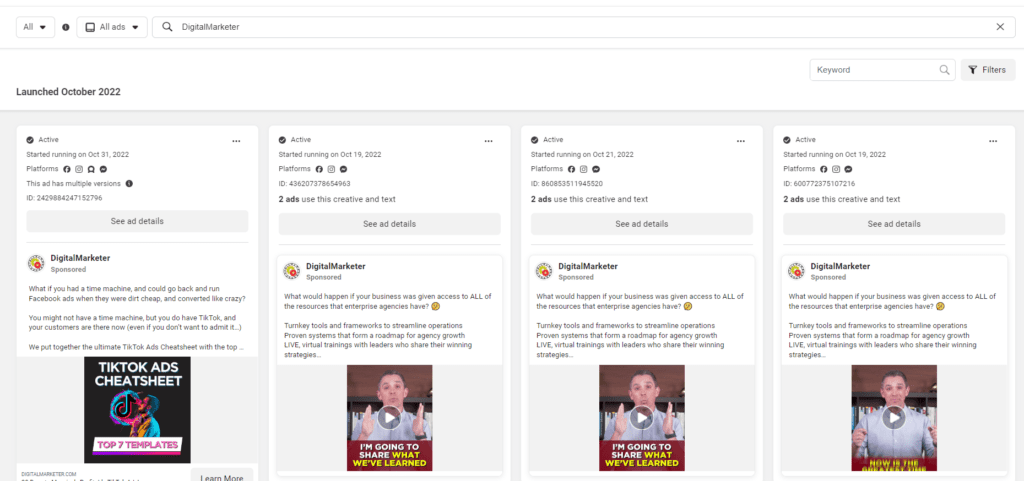
You can filter by:
- Country: Narrow results to ads targeting a specific market. This is especially useful if you are running region-specific campaigns or studying how a brand localizes its messaging.
- Platform: As of late 2025, the Ad Library now includes filters for Threads and WhatsApp ads, letting you isolate competitor campaigns on each of Meta’s six platforms individually: Facebook, Instagram, Messenger, Audience Network, Threads, and WhatsApp.
- Media type: Filter by image, video, or carousel to study which creative formats a competitor favors.
- Active status: See only currently running ads, or include recently ended campaigns.
- Impressions by date: For political and social issue ads, filter by date range to study spending patterns over time.
- Language: Useful when you are researching multilingual campaigns or localized messaging approaches.
A newer addition worth noting: a low impression count label now appears on ads with fewer than 100 impressions. This helps you distinguish between a newly launched ad that is still in early delivery and one that has been running for two weeks but failed to gain any traction. The context matters when you are drawing conclusions about what is working for a competitor.
What to Look for When Researching Competitors
Browsing the Ad Library is easy. Extracting useful intelligence from it takes a bit more focus. Here is what I pay attention to when I research a competitor or start working with a new client.
Creative format mix
Look at the ratio of static images to videos to carousels. If a competitor has shifted heavily toward video over the past few months, that tells you something about what is producing results for them. Brands do not invest in video production at scale unless they are seeing returns.
Ad volume and testing cadence
Count how many active ads a competitor is running at once. If a brand has 40 or 50 variations of the same product ad live simultaneously, they are running creative tests at scale. This has become much more common since Meta expanded its Advantage+ creative tools. A brand running three ads is in a different place strategically than one running three hundred.
Ad longevity
Check the “Started running on” date for each ad. An ad that has been active for several weeks or months is almost certainly performing well, because advertisers rarely keep spending on underperforming creative for that long. These long-running ads are worth studying closely. Look at the hook, the visual style, the offer structure, and the call to action.
Copy and messaging patterns
Read the ad copy across several of a competitor’s active ads. You will start to notice patterns: the pain points they lead with, the benefits they emphasize, the tone they use (casual, authoritative, urgent), and whether they rely on social proof, testimonials, or direct offers. This gives you a map of their positioning that is more honest than anything on their website, because ad copy is optimized for conversion, not branding.
Landing page URLs
The Ad Library shows the destination URL for each ad. Click through to see where competitors are sending traffic. Are they sending people to a product page, a lead magnet, a quiz, or a long-form sales page? The landing page strategy tells you as much about their funnel as the ad itself.
Viewing an Advertiser’s Full Ad Activity
Beyond individual ads, the Ad Library lets you see an advertiser’s overall presence on the platform. To do this, click on the “See ad details” button on any ad, then click “See all.” This takes you to the Ad Library page for that specific advertiser, where you can view every active ad they are running and see detailed information about each one.
This is the view I use most often. Instead of searching by keyword and getting a mix of advertisers, going directly to a specific competitor’s page gives you their full creative portfolio in one place. You can quickly see how many campaigns they are running, which products or offers they are promoting most heavily, and how their messaging has shifted over time.
Ad Library Data for Political and Social Issue Ads
The Ad Library provides significantly more data for ads categorized as political, electoral, or social issue ads. For these ad types, you can see estimated spend ranges, impression counts, and demographic breakdowns by age, gender, and region.
According to Meta’s Transparency Center documentation on Ad Library tools, political and social issue ads are archived for seven years regardless of whether they are still active. This makes the Ad Library a valuable long-term research resource for journalists, academic researchers, and policy analysts tracking political advertising trends.
One important change to be aware of: as of October 2025, Meta stopped accepting new political, electoral, or social issue ads in the European Union in response to the EU’s Transparency and Targeting of Political Advertising (TTPA) regulation. Existing ads remain in the archive, but no new entries are being added in that region. Outside the EU, political ad transparency continues as before.
For commercial ads in the EU and UK, the Ad Library displays them while active and archives them for one year after the last impression is delivered.
Beyond the Basic Interface: The Ad Library API and Report
If you need to analyze ads at scale, the basic web interface has limits. Meta offers two additional tools for deeper research.
The Ad Library API gives developers programmatic access to the Ad Library database. You can query by keyword, advertiser ID, country, platform, media format, and language, and receive structured data back in JSON format. The API is particularly useful for building competitive intelligence dashboards, running bulk creative analysis, or monitoring specific advertisers over time. Access requires a Meta developer account and an approved access token.
The Ad Library Report provides an aggregated, downloadable view of ad spending and activity for political and social issue ads in a given country and time period. This is useful for researchers who need summary-level data rather than individual ad records.
Meta also offers an Ad Targeting dataset for approved researchers, which includes targeting information selected by advertisers who ran political or social issue ads after August 2020 in more than 120 countries.
There is also a branded content search feature that covers public posts on Facebook and Instagram carrying a “paid partnership” label. This lets you track influencer and creator partnerships alongside traditional paid ads.
How to Interpret AI-Generated Ad Creative in the Ad Library
If you have browsed the Ad Library recently, you have probably noticed that many brands are running far more ad variations than they used to. A single advertiser might have dozens of versions of the same campaign live at once, each with slightly different backgrounds, text overlays, or image treatments. This is not because creative teams suddenly got faster. It is because Meta’s AI tools are now doing much of the production work.
At Cannes Lions in June 2025, Meta introduced 11 generative AI features for advertisers, including image-to-video conversion that stitches up to 20 product photos into polished video clips, AI-generated background replacement, brand-safe automation that pulls in logos, fonts, and color palettes automatically, and AI-generated product highlight overlays. Meta reported that Advantage+ Sales Campaigns using these tools deliver an average 22% improvement in return on ad spend.
Later in 2025, Meta rolled out its GEM ranking model and expanded the Andromeda ad retrieval system, both of which work behind the scenes to decide which ad variation gets served to which user. The practical result is that advertisers can upload a handful of base assets and Meta’s system generates, tests, and optimizes dozens of variations automatically.
This matters for your Ad Library research in a few ways.
First, a high number of active ads from one brand does not necessarily mean they have a massive creative team or a huge budget. It may mean they are leaning heavily on Advantage+ creative tools to generate variations from a smaller number of base concepts. Look at the underlying structure of the ads rather than just counting them. Do 30 ads all share the same product shot with different backgrounds? That is AI-generated variation, not 30 distinct creative ideas.
Second, pay attention to which variations have been running the longest. Meta’s system automatically shifts budget toward the best-performing variations, so the ones with the oldest start dates are the ones that survived the testing process. Those are the ads worth studying in detail.
Third, watch for brand consistency signals. Meta now lets advertisers upload brand kits with approved logos, colors, and fonts that constrain what the AI can generate. Brands that use this feature will have a consistent look across dozens of variations. Brands that don’t will have a more scattered visual identity across their ads, which can be a competitive weakness you can capitalize on.
Practical Ways to Use the Ad Library for Your Campaigns
Here are the specific use cases where the Ad Library provides the most value.
Competitor research before launching a new campaign
Before you write a single line of ad copy, search the Ad Library for three to five direct competitors. Look at their active ads, note the messaging angles they are using, identify which formats they favor, and check how long their top ads have been running. This gives you a baseline for what the market is already seeing, so you can position your ads to stand apart rather than blend in.
Creative inspiration when you are stuck
If your creative output has gone stale, the Ad Library is a better source of inspiration than a mood board. Search by industry keywords rather than specific competitors. You will find ads from brands you have never heard of, in markets you have never considered, using approaches that might translate directly to your campaigns.
Identifying format trends in your vertical
Are competitors in your space shifting from static images to Reels-style video? Are carousel ads making a comeback? Is UGC-style creative outperforming polished studio work? The Ad Library lets you answer these questions with live data instead of guesswork.
Validating your messaging before spending money
If you are considering a new angle, like leading with a specific pain point or testing a new offer structure, search the Ad Library to see if anyone in your space is already running something similar. If a competitor has been running that angle for months, it is probably working. If nobody is doing it, you might have found a gap, or you might be about to learn why nobody else tried it.
Client onboarding and pitch preparation
I use the Ad Library every time I take on a new client. Within 15 minutes, I can pull up everything their competitors are running, identify the dominant messaging themes in their vertical, and spot opportunities they are not taking advantage of. It is one of the fastest ways to demonstrate that you understand a client’s competitive environment.
Tips for Getting the Most Out of the Ad Library
A few things to keep in mind as you build the Ad Library into your regular workflow:
- The Ad Library does not show performance data for commercial ads. You cannot see click-through rates, conversion rates, or cost per acquisition. You can only infer performance from ad longevity and creative volume. An ad that has been running for eight weeks is almost certainly profitable. An ad that disappeared after three days probably was not.
- You cannot see targeting information for commercial ads. Political and social issue ads show some demographic data in the EU and UK, but standard commercial ads do not reveal who they are targeted to. You can sometimes infer targeting from the creative itself (a product shot featuring a specific demographic, copy written for a particular life stage), but the actual audience settings are not visible.
- Use the desktop version for serious research. The mobile experience is functional but limited. Filtering, scanning, and comparing multiple advertisers is significantly easier on desktop.
- Check the Ad Library regularly, not just once. A single snapshot gives you a moment in time. Checking back every two to four weeks shows you how competitors are evolving their strategy, what they are testing, and what they have pulled.
- Cross-reference with Meta’s Transparency Center. For regulated industries or political research, combine what you see in the Ad Library with the broader data available at Meta’s Transparency Center, which includes the Content Library for organic branded content and additional research tools.
Conclusion
The Meta Ad Library is a tool I use every time I take on a new client, need creative inspiration, or want to understand how competitors are spending their ad budgets. It has grown significantly since its launch, and with the addition of Threads and WhatsApp filters, AI creative tool context, and expanded transparency for EU advertisers, it is more useful now than it has ever been.
The information is free, it is public, and it updates in real time. Most marketers look at it once and forget about it. The ones who build it into a regular research habit tend to make better creative decisions, spot market shifts earlier, and waste less budget testing angles that someone else already proved do or do not work.
If you have not visited the Ad Library recently, go take a look. Search for your top three competitors and spend 20 minutes studying what they are running right now. You will almost certainly find something you can use.
Facebook ad library works like a miracle
It’s amazing!
FB Ad Library really saved my life, I’m grateful. I hope your article reaches a wide audience. I tried to add another resource that I benefited from, I recommend you to take a look.
Thank you for sharing your positive experience with the Facebook Ads Library, Emily. It’s great to hear that this tool was helpful for you. The more we can educate ourselves on the tools available, the better prepared we can be to create effective ad campaigns.